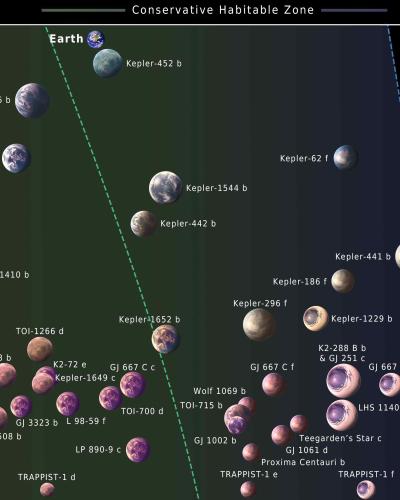
Among the amazing diversity of more than 6000 exoplanets that circle other stars, CSI researchers identified the 45 rocky worlds that could potentially allow for life - the best observation candidates among rocky exoplanets in the Habitable Zone. But in addition to identifying the most interesting worlds to explore, we found the ones that can help us solve the mysteries of if a planet can stay habitable, and for how long. The intriguing worlds that are near the edges of the habitable zone can shed light on where habitability ends and if our ideas of what limits it proves correct, while those with unusual elliptical orbits around their star can trace the importance of a changing amount of heat hitting a world.
While the idea of the Habitable Zone has been developed since the 70s, observations will prove critical to prove it right - or if it needs adaptation. Three students in the Carl Sagan Institute (Lucas Lawrence ‘23, Gillis Lowry ’24, and Abigail Bohl ‘26) teamed up under CSI Director Lisa Kaltenegger to create an up-to-date catalog of all currently discovered rocky planets in the habitable zone, and identified the best planets to observe with powerful telescopes like the JWST. You can read more about the project in the Cornell Chronicle, and explore interactive graphs adapted from the science paper by one of the first authors, Gillis Lowry.
Exoplanets and astrobiology play a major part in "Project Hail Mary" - see here for CSI commentary.